Taian AEM Machinery Co.,Ltd
Tel:+86 18888260296
Whatsapp:+86 18888260296

News
Water Pump Impeller Balancing
Water Pump Impeller Balancing
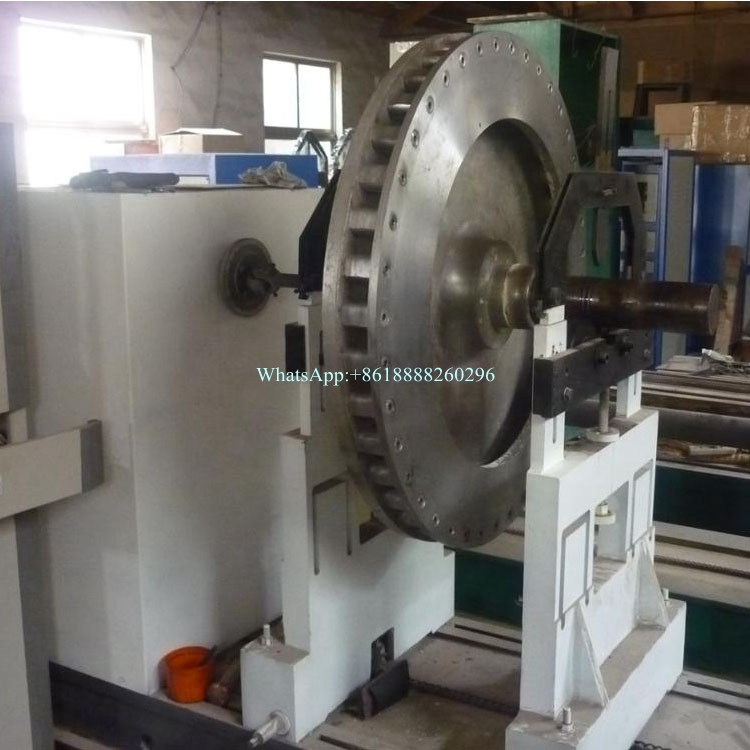
Water pump impellers are critical components where balance directly impacts the pump's hydraulic efficiency, energy consumption, and the longevity of the mechanical seals and bearings. Even a small amount of residual unbalance in a water pump leads to cavitation, excessive vibration, and leakage at the seals.
1. Unique Challenges in Pump Impeller Balancing
-
Hydrodynamic Balance: Beyond just mass distribution, the impeller interacts with fluids. High-precision balancing is required to ensure that the water flow remains laminar and doesn't cause premature wear on the pump housing or impeller vanes.
-
Corrosion & Buildup: Because pumps handle liquids, impeller weight can change over time due to mineral buildup, erosion, or corrosion. Balancing during the manufacturing phase must be high-precision to provide a "buffer" for these operational changes.
-
Complex Geometry: Impellers (especially closed-vane designs) are often hollow or have complex internal shapes, making weight removal/addition tricky.
2. Balancing Approach: Vertical vs. Horizontal
A. Vertical Balancing (Recommended for Impellers)
Most pump impellers are disk-shaped or short cylinders.
-
The Method: Using a Vertical Balancing Machine, the impeller is mounted on a vertical mandrel.
-
Why: It is the fastest way to handle these parts. It allows for easy access to the hub and the outer shroud for correction (drilling or grinding). It is the standard for high-volume production of residential and industrial pump impellers.
B. Horizontal Balancing (Recommended for Pump Shaft Assemblies)
When the impeller is mounted onto a long pump shaft, the entire assembly must be balanced together.
-
The Method: Using a Horizontal Balancing Machine (YYQ or YYW series).
-
Why: The cumulative unbalance of the shaft, the impeller, and any keys or couplings must be addressed as a single rotating system. This is crucial for multi-stage pumps or high-pressure centrifugal pumps.
3. Correction Methods
-
Material Removal (Shrouds/Hubs): The most common method. Using a mill or drill to remove material from the heavier side of the impeller shroud.
-
Adding Weights: Sometimes, small weights are added to the hub if removing material is not possible due to structural integrity concerns.
-
Vane Trimming: In some cases, a small portion of an impeller vane is carefully ground down to adjust the balance, though this must be done within strict hydraulic design limits to avoid changing the pump's performance curve.
【 Go Back 】 | 【 Print 】 | 【 Close this window 】
Contact us
ADD: No.96,Changcheng Road,Tai'an City,Shandong Province,China
Official Social Media


