Taian AEM Machinery Co.,Ltd
Tel:+86 18888260296
Whatsapp:+86 18888260296
News
Electric Motor Rotor Balancing
Electric Motor Rotor Balancing
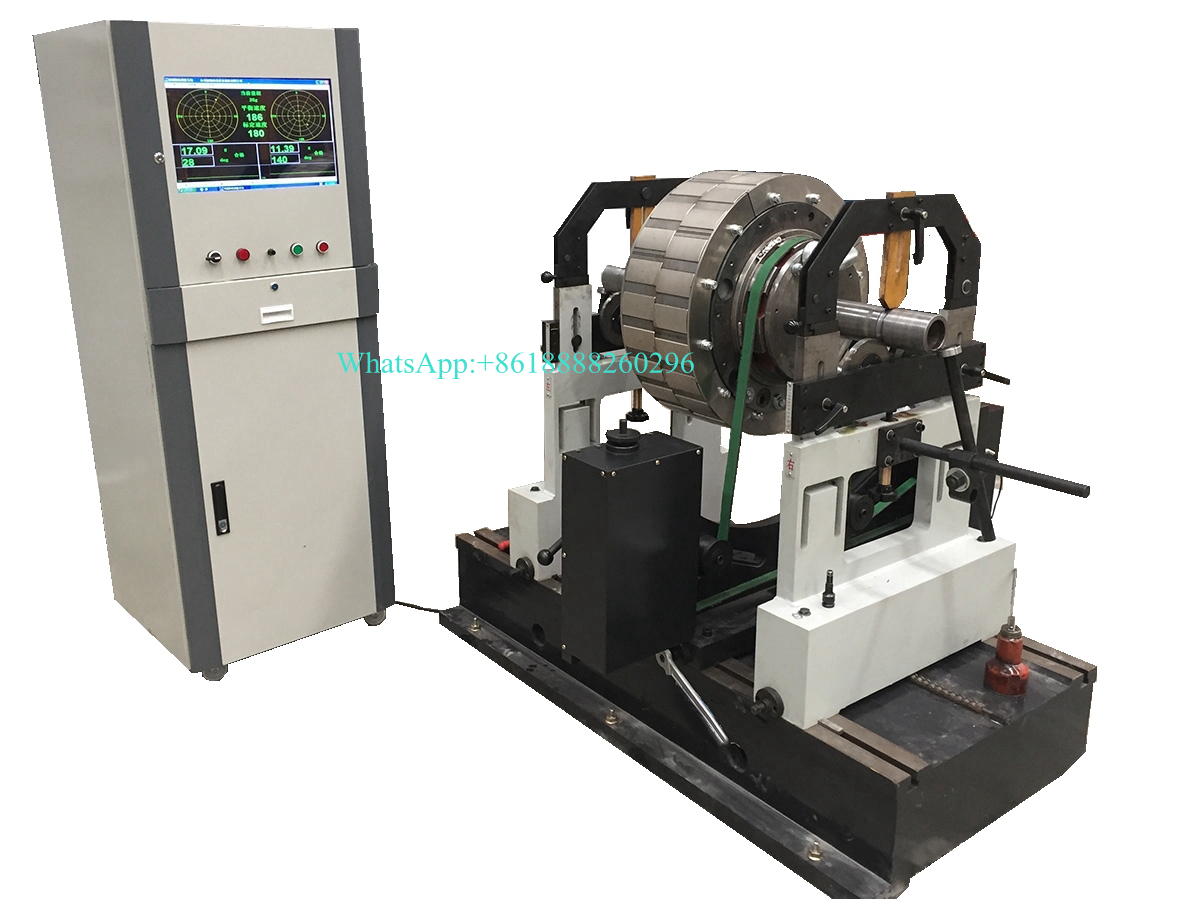
The motor rotor is one of the most common and critical components balanced in industrial manufacturing. Because electric motors operate at high rotational speeds, even a microscopic amount of unbalance can cause severe vibrations, bearing wear, noise, and premature motor failure.
1. Why Motor Rotors Need Balancing
During the manufacturing process (due to casting voids in the lamination stack, variations in copper winding density, machining tolerances, or shaft eccentricity), the center of mass of a motor rotor rarely aligns perfectly with its geometric rotational axis.
When the motor spins at speeds ranging from $1,500\text{ RPM}$ to over $20,000\text{ RPM}$, this eccentricity generates destructive centrifugal forces. Dynamic balancing ensures:
-
Smooth Operation & Low Vibration: Prevents mechanical resonance and structural fatigue.
-
Extended Bearing Life: Eliminates radial loads that destroy motor bearings.
-
High Efficiency & Low Noise: Essential for commercial, industrial, and high-precision applications.
2. Common Types of Motor Rotors
Different motor designs require specific handling during the balancing process:
-
Squirrel-Cage Rotors (Induction Motors): Common in industrial and household AC motors. Usually balanced using belt-drive horizontal machines, with correction done by drilling the end rings or balancing webs.
-
Wound Rotors & Armatures: Found in DC motors and universal motors, featuring copper windings and commutators. Precision balancing is critical here to protect fragile commutators and wiring.
-
Permanent Magnet (PM) Rotors / EV Rotors: Used in electric vehicles and high-performance servo motors. These often require ultra-high precision (ISO $G1$ or $G2.5$) and specialized non-magnetic tooling if magnets are already installed.
-
High-Speed Spindle Rotors: Used in CNC machinery, requiring micro-gram precision at extreme RPMs.
3. Recommended Balancing Solutions (AEM Portfolio)
-
For Mass Production of Small to Medium Armatures/Rotors:
-
Use Belt-Drive Horizontal Machines (YYQ Series). The belt drive ensures fast, scratch-free loading and unloading, making it ideal for high-throughput motor manufacturing lines.
-
-
For High-Volume Automated Lines:
-
Use Automatic Balancing Machines with Integrated Milling/Drilling. These systems measure the rotor, calculate the unbalance, mill or drill the correction weight, and verify the result in seconds.
-
-
For Large Industrial Motor Rotors:
-
Use Heavy-Duty Horizontal Machines (YYW Universal Joint Series) for large, high-torque industrial motors.
-
【 Go Back 】 | 【 Print 】 | 【 Close this window 】
Contact us
ADD: No.96,Changcheng Road,Tai'an City,Shandong Province,China
Official Social Media


