Taian AEM Machinery Co.,Ltd
Tel:+86 18888260296
Whatsapp:+86 18888260296
News
Crankshaft Balancing
Crankshaft Balancing
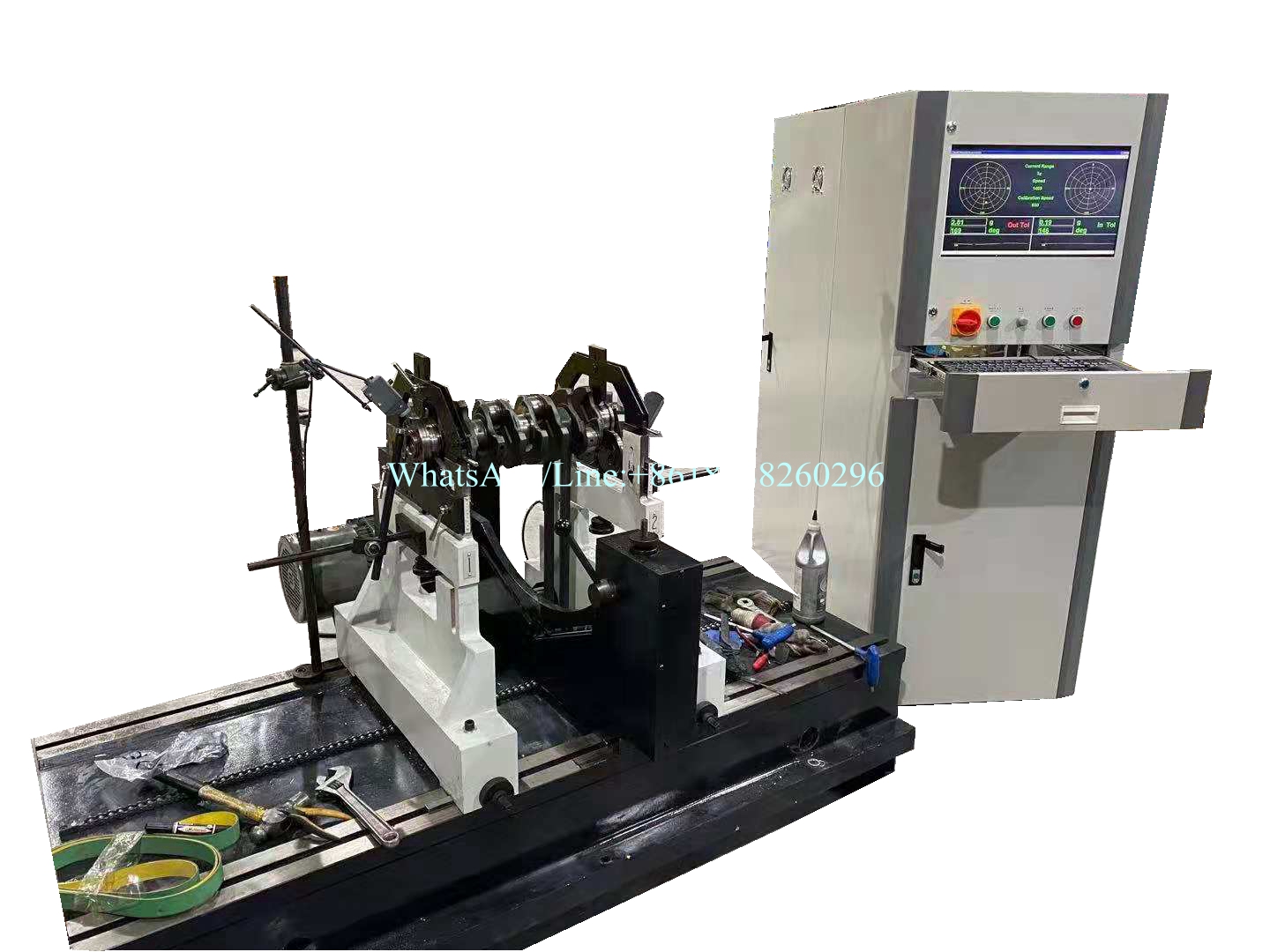
The crankshaft is the beating heart of an internal combustion engine, converting linear piston motion into rotational power. Because it is a heavy, asymmetric component subjected to immense reciprocating and centrifugal forces, dynamic balancing is non-negotiable for engine longevity, smoothness, and performance.
1. Unique Challenges in Crankshaft Balancing
-
Complex Asymmetry: Unlike simple cylindrical rollers, a crankshaft features offset crankpins, counterweights, and varying mass distribution along its length. Balancing requires treating it as a complex spatial vector system.
-
Reciprocating vs. Rotating Weight: In engines, the crankshaft must not only balance its own rotating mass (journals and crank webs) but also account for a portion of the reciprocating mass (pistons and connecting rods). This is often simulated using balancing bobs (weight blocks) attached to the crankpins during the testing process.
-
High Inertia and Weight: Crankshafts range from small, multi-cylinder passenger car units to massive multi-ton marine diesel shafts, requiring extreme structural rigidity from the balancing machine.
2. Recommended Balancing Machine: Universal Joint Drive (YYW Series)
Because crankshafts have massive start-up inertia, complex shapes, and require rigid torque transmission during acceleration, they are almost exclusively balanced on Horizontal Universal Joint Drive Machines (YYW Series).
-
Positive Drive: The rigid cardan shaft connection prevents any slip, ensuring the heavy crankshaft is accelerated smoothly and safely.
-
Heavy-Duty Pedestals: Built to absorb the high loads and vibrations of multi-cylinder components.
-
Two-Plane (Dynamic) Balancing: Essential for long crankshafts to eliminate both static unbalance (force) and couple unbalance (wobble).
3. The Balancing & Correction Process
-
Simulation (Bobweights): For engine crankshafts, heavy balancing bobs representing the connecting rods and pistons are securely clamped to the crankpins to replicate true engine operating dynamics.
-
Measurement: The AEM YYW machine spins the assembly, precisely calculating the unbalance magnitude and angular location across multiple correction planes.
-
Correction (Material Removal):
-
Drilling or Milling: Removing material from the heavy outer edges of the counterweights.
-
Counterweight Profiling: Occasionally pocketing or drilling axial holes into the crank webs to safely remove mass without compromising structural integrity.
-
4. Technical Guidance for Clients
When pitching to automotive manufacturers, engine rebuilders, or heavy-machinery shops, emphasize these key value points:
-
Elimination of Engine Vibration: "Perfectly balanced crankshafts eliminate destructive engine harmonics, protecting block integrity and reducing driver fatigue."
-
Extended Bearing & Component Life: "By removing centrifugal forces that cause main and rod bearing wear, our balancing solutions significantly extend engine life."
-
High-Torque Stability: "The robust design of our YYW U-Joint series ensures safe, stable, and high-precision balancing even for heavy multi-cylinder diesel and racing crankshafts."
【 Go Back 】 | 【 Print 】 | 【 Close this window 】
Contact us
ADD: No.96,Changcheng Road,Tai'an City,Shandong Province,China
Official Social Media


