News
Belt-Drive Dynamic Balancing Machines
Belt-Drive Dynamic Balancing Machines
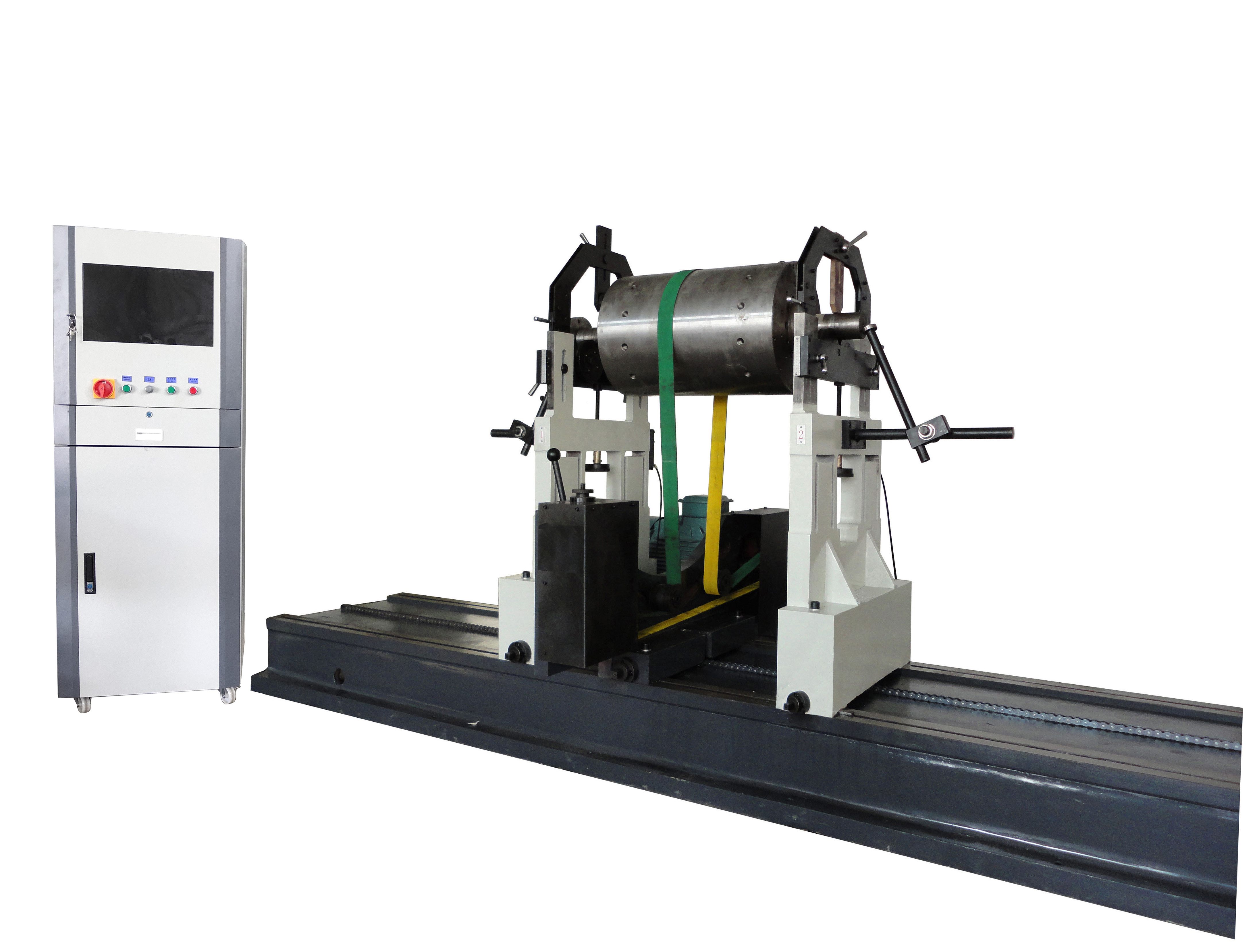
Belt-drive dynamic balancing machines are one of the most widely used types of horizontal balancing equipment in general industry. They utilize an endless flexible belt (often made of flat rubber or fabric-reinforced material) to friction-drive the rotor during testing.
1. How It Works
-
The Drive Mechanism: A motor-driven pulley system spins a continuous flat belt. The belt wraps around the cylindrical surface (or a specialized pulley/journal section) of the rotor.
-
Friction Transmission: The friction between the moving belt and the rotating surface drives the workpiece up to the desired balancing speed.
-
Decoupling/Free Rotation: Once the rotor reaches the testing speed, the drive motor disengages or the belt tension is instantly released, allowing the rotor to spin freely on its supports (or the belt slips naturally). The sensors then measure the unbalance signals completely free from any mechanical interference of the drive motor or rigid couplings.
2. Key Advantages
-
High Measurement Accuracy (No Coupling Error): Because there is no rigid coupling (like a universal joint shaft) attached to the rotor, there is zero transmission error or residual force from a drive shaft. This makes belt-drive machines exceptionally accurate.
-
Extremely Fast Loading & Unloading: There are no bolts, flanges, or universal joints to fasten. The operator simply places the rotor onto the rollers, loops the belt over it, and starts the cycle. Once finished, the belt is lifted off, and the rotor can be removed instantly. Ideal for high-throughput batch production.
-
Versatility / Wide Range of Workpieces: One belt-drive machine can handle a vast variety of smooth cylindrical rotors (such as motor armatures, spindle shafts, small rollers, and turbocharger shafts) without needing custom adapter flanges for every different part design.
-
Surface Protection: High-quality anti-static and wear-resistant belts protect the rotor's surface finish from scratching or mechanical wear during high-speed rotation.
3. Typical Applications
Belt-drive machines (such as the standard YYQ series) are best suited for cylindrical, smooth-surfaced rotors that have a suitable outer diameter for the belt to wrap around:
-
Electric motor rotors and armatures
-
Small to medium industrial rollers and textile spindles
-
Turbocharger shafts and compressor wheels
-
Centrifugal pump shafts and small fan rotors
-
Automotive alternator and starter armatures
4. Technical Comparison: Belt Drive vs. Universal Joint Drive
| Feature | Belt Drive | Universal Joint Drive |
| Connection Method | Friction belt (non-rigid) | Mechanical coupling / Flange |
| Setup / Changeover Speed | Instant (very fast loading) | Slower (requires bolting flanges/adapters) |
| Transmission Interference | None (decoupled during measurement) | Low to moderate (inherent coupling mass/balance) |
| Best Rotor Types | Smooth cylindrical parts without drive slots | Heavy-duty, high-torque rotors with shaft ends/flanges (e.g., drive shafts, heavy crankshafts) |
【 Go Back 】 | 【 Print 】 | 【 Close this window 】


