Taian AEM Machinery Co.,Ltd
Tel:+86 18888260296
Whatsapp:+86 18888260296
News
Automatic Balancing Machines
Automatic Balancing Machines
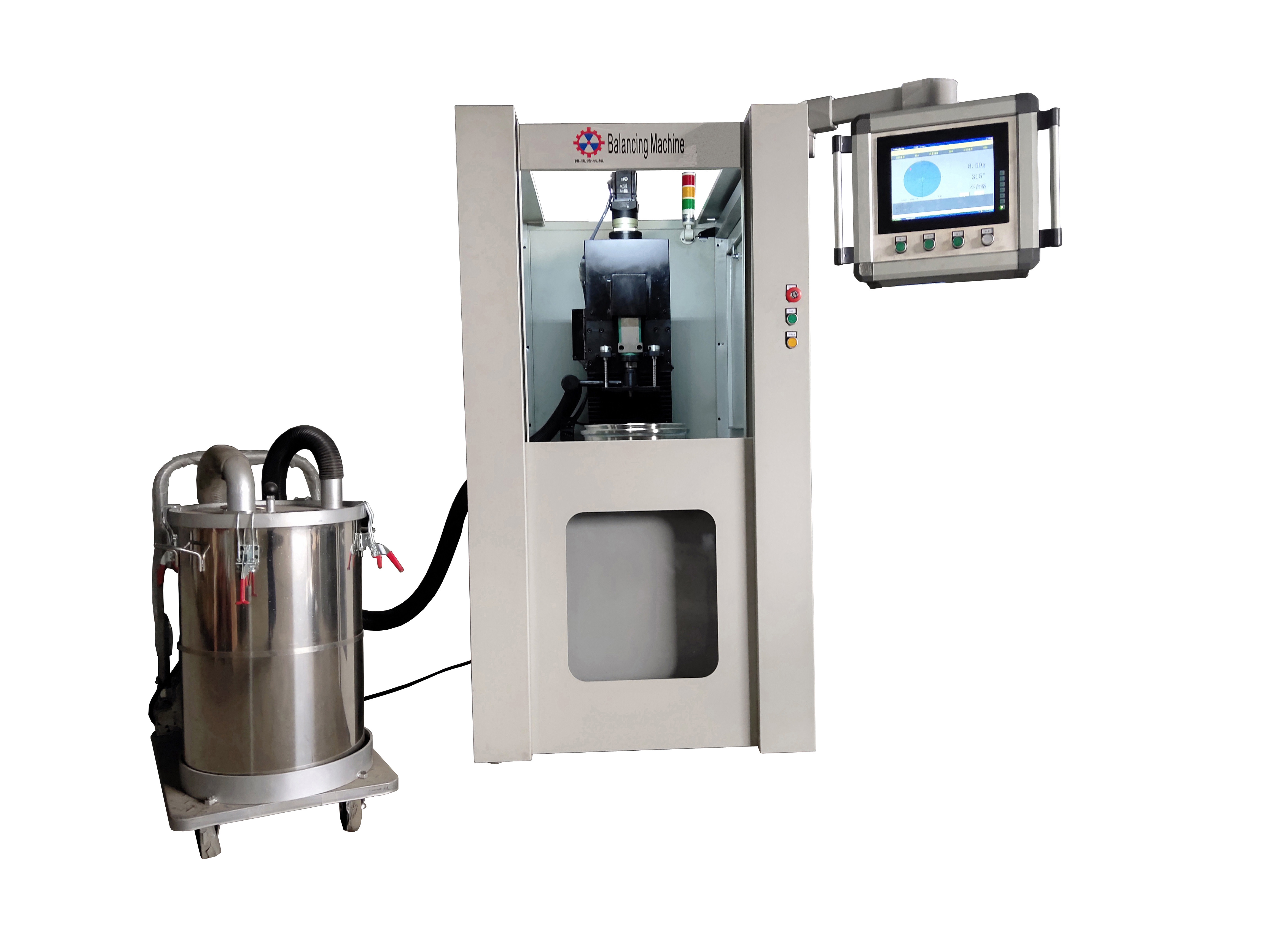
Automatic Balancing Machines represent the pinnacle of production efficiency. Unlike semi-automatic or manual systems where an operator must measure the unbalance and then physically remove or add weight, an automatic machine performs the entire "Measure-Correct-Verify" cycle without human intervention.
These are the "all-in-one" solution for high-volume manufacturing environments.
1. How It Works (The Automated Loop)
The machine is typically integrated into an assembly line and follows a standardized, computer-controlled sequence:
-
Automatic Loading: A robotic arm or conveyor system places the rotor into the machine.
-
Automatic Measurement: The machine spins the rotor, calculates the magnitude and angle of unbalance, and stops at the precise correction position.
-
Automatic Correction: A built-in unit (e.g., a high-speed drill or milling head) automatically moves to the designated spot and removes exactly the amount of material required.
-
Automatic Verification: The machine performs a final spin to confirm the residual unbalance is within the specified ISO grade.
-
Automatic Unloading: The finished, balanced rotor is moved to the next station on the production line.
2. Key Advantages
-
Massive Productivity Gains: By eliminating the time-consuming manual steps of marking, moving, and correcting, cycle times can be reduced to just a few seconds per part.
-
Unmatched Consistency: Human error (in reading, measuring, or grinding) is entirely removed. Every rotor is balanced to the exact same high standard.
-
Reduced Labor Costs: A single operator can manage multiple automatic lines, drastically lowering the cost per piece.
-
Clean & Safe: Since correction is contained within the machine, there are no loose metal chips or dust at the workstation.
3. Common Correction Methods
Automatic machines are usually specialized to perform one or two specific correction tasks at high speed:
-
Automatic Drilling: Most common for flywheels, pulleys, and brake discs.
-
Automatic Milling: Often used for complex motor armatures or rotor segments.
-
Automatic Weight Insertion: Sometimes used to "clip" or "stick" balancing weights onto rotors (e.g., automotive fan assemblies).
4. When to Invest in Automatic Balancing
You should recommend these machines to customers who:
-
Have High Production Volume: If a customer produces hundreds or thousands of identical parts per day, the ROI for an automatic machine is very high.
-
Require Strict Quality Control: If the tolerance is so tight that manual correction is too risky or prone to error.
-
Are Implementing Smart Factory/Industry 4.0: Automatic machines are "ready to plug in" to factory automation systems and IoT monitoring.
Comparison: Manual vs. Automatic
| Feature | Manual/Semi-Automatic | Automatic Balancing |
| Cycle Time | Minutes per part | Seconds per part |
| Labor Intensity | High (constant interaction) | Low (supervisory only) |
| Consistency | Operator-dependent | Machine-guaranteed |
| Capital Investment | Moderate | High |
| Production Scale | Small batch / Job shop | High-volume production lines |
【 Go Back 】 | 【 Print 】 | 【 Close this window 】
Contact us
ADD: No.96,Changcheng Road,Tai'an City,Shandong Province,China
Official Social Media


